
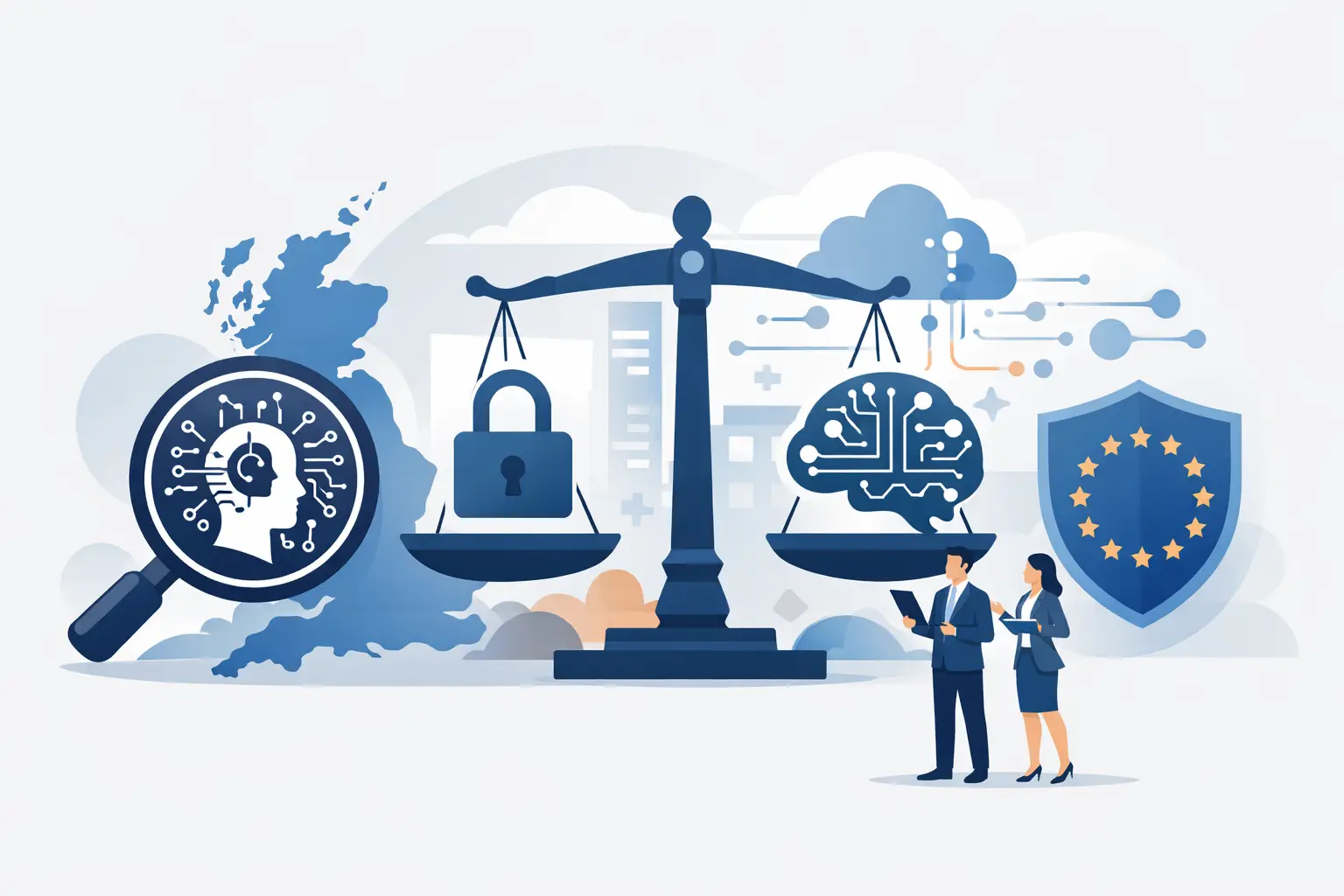
When an investigation team starts using AI to draft witness summaries, compare accounts or assemble chronologies, the legal question is rarely whether the tool saves time. The real issue in UK GDPR AI investigations is whether those efficiencies can stand up to scrutiny when personal data, special category material and procedural fairness are all in play.
For institutions handling disciplinary, regulatory or employment matters, AI changes the risk profile of case administration. It can reduce manual effort and improve consistency, but it can also introduce uncertainty around lawful basis, transparency, data minimisation and human oversight. If the system is not designed for sensitive casework from the outset, the problem is not only compliance. It is defensibility.
Why UK GDPR AI investigations are receiving closer attention
The direction of travel is clear. Regulators and affected parties are asking more precise questions about how AI tools are used in decision-support processes, especially where the underlying material includes allegations, health data, safeguarding concerns, trade union membership, criminal offence data or other high-sensitivity records.
In formal investigations, the stakes are higher than in general office automation. Case files are often built from contested evidence. Statements may conflict. Notes may be incomplete. Relevance can change as the matter develops. An AI tool working across that material is not merely processing text. It is operating inside an evidential chain that may later be challenged by a respondent, representative, panel or court.
That is why UK GDPR AI investigations tend to focus on a small number of practical questions. What personal data entered the model? On what lawful basis? Was the use proportionate? Was a data protection impact assessment required? Who reviewed the output? Could the organisation explain the process afterwards?
The compliance issues that matter most in practice
Lawful basis is only the starting point
Many organisations assume that if the original investigation had a lawful basis, any AI-assisted processing that follows must also be lawful. That is too simplistic. The use of an AI tool may still be compatible with the original purpose, but it needs to be assessed properly rather than assumed.
For employment, regulatory and safeguarding contexts, the lawful basis often sits alongside conditions for processing special category data or criminal offence data. The analysis needs to cover the actual task the AI is performing. Drafting an internal chronology from existing documents is not the same as profiling subjects for future risk. Summarising evidence for a case officer is not the same as making an automated determination.
The more sensitive the case material, the less room there is for vague justifications. Organisations need to be able to show why the AI use was necessary, what was proportionate, and what safeguards were in place.
Transparency cannot be treated as an afterthought
Transparency in this context does not always mean disclosing every technical detail of a model. It does mean being clear about how personal data may be used in the investigation process, including where AI assists with preparation or analysis.
What counts as sufficient transparency depends on the setting. Internal employee investigations, professional discipline and regulatory matters each have different expectations and procedural frameworks. Even so, the common principle is straightforward: if AI materially supports the handling of personal data in the case, the organisation should not be vague about it.
Poor transparency creates two problems. First, it weakens data protection compliance. Second, it invites procedural challenge. A party who believes technology has influenced the treatment of their evidence without clear disclosure is more likely to question the fairness of the process as a whole.
Data minimisation is harder than it looks
Generic AI tools often encourage broad uploading. Entire folders are dropped into a system because it is faster than selecting only what is needed. In investigation work, that approach is risky.
Case files frequently contain peripheral correspondence, unrelated identifiers, prior matters, medical references or legally privileged content. If those documents are ingested without control, the organisation may be processing far more personal data than necessary for the specific task. That is exactly the sort of operational failure that attracts scrutiny.
A defensible approach usually means structured workflows, scoped permissions and clear separation between the task at hand and the wider repository. If the goal is to generate a witness statement draft from approved source material, the system should support that precise activity rather than exposing the entire case archive.
High-risk processing means DPIAs need real attention
A data protection impact assessment is not a box-ticking exercise in this area. Where AI is used in formal case handling, a DPIA is often the document that shows whether the organisation has thought seriously about necessity, proportionality and risk.
That is particularly true if the processing involves vulnerable individuals, special category data, criminal allegations, large-scale file review or any function that could materially affect outcomes. A weak DPIA tends to fail in predictable ways. It describes the tool in general terms, says little about the investigation workflow, and does not explain how human reviewers intervene.
A stronger DPIA maps the actual case lifecycle. It identifies what data enters the system at referral stage, what AI tasks are permitted, how outputs are checked, where records are stored, who can access them, and how audit evidence is preserved. It also addresses error risk. AI does not need to make final decisions to cause harm. A flawed summary or incomplete chronology can still shape an investigator’s view if controls are poor.
Security and processor due diligence are central to UK GDPR AI investigations
Where the data goes matters
Many of the most difficult questions in UK GDPR AI investigations are not about AI in the abstract. They are about infrastructure, processor terms and data flows. If sensitive investigation material is routed through vendors with unclear retention practices, cross-border transfers or model training rights, the compliance position becomes much harder to defend.
Institutional users should expect precision here. They need to know where data is hosted, whether prompts or uploaded files are retained, whether customer material is used to train models, and how encryption is handled in transit and at rest. They also need contractual clarity on processor responsibilities and sub-processor arrangements.
For high-sensitivity investigations, European hosting, strict access controls, encryption standards and verifiable audit trails are not optional extras. They are baseline safeguards.
Auditability is as important as confidentiality
Security is often discussed in terms of preventing unauthorised access. That matters, but investigation teams also need evidence of what happened inside the system. Who uploaded a statement? When was an AI-generated summary produced? Which documents informed it? Who approved the final version?
Without that record, the organisation may struggle to answer later questions from internal reviewers, regulators or external representatives. In other words, a secure system that cannot show its own process is still a weak system for formal proceedings.
This is where purpose-built platforms differ from general productivity tools. In sensitive casework, audit trails are part of governance, not merely an administrative convenience.
Human oversight must be operational, not rhetorical
It is easy to say that AI outputs are reviewed by a human. The harder question is what that review looks like in practice.
If a case officer receives an automatically generated chronology, there should be a defined step for checking source references, factual omissions and contested interpretations. If a referral report is drafted with AI assistance, the reviewer should confirm that the language is neutral, accurate and aligned with the evidence. If witness accounts are cross-checked automatically, discrepancies should be assessed by a trained person who understands context rather than treated as proof of inconsistency.
This matters because investigation work is full of nuance. Two statements may differ because of perspective, timing, trauma, terminology or incomplete records. AI can surface patterns quickly, but it cannot resolve credibility or fairness on its own. Over-reliance on machine-generated structure can produce false confidence, which is often more dangerous than obvious error.
What good practice looks like for investigation teams
The strongest position is usually a controlled one. Use AI for bounded preparation tasks, keep a clear human decision-maker, restrict unnecessary data exposure and preserve a full audit record. That approach does not eliminate risk, but it keeps the organisation within a defensible framework.
Practically, that means selecting tools built for the full case lifecycle rather than repurposing consumer-grade systems for formal proceedings. Referral intake, evidence handling, chronology building, witness statement drafting, hearing bundle preparation and outcome recording should sit inside one secure platform where access, retention and process controls are designed around sensitive investigations. That is the model platforms such as Endaxi Brief are built to support.
There is no single answer to every UK GDPR AI investigation. The right controls depend on the category of case, the volume and sensitivity of material, the role AI plays, and the degree to which outputs influence subsequent decisions. But the pattern is consistent. Where organisations can show disciplined data handling, clear purposes, meaningful oversight and system-level auditability, AI becomes easier to justify.
The useful question is not whether AI belongs in investigations. It is whether your process can explain, contain and evidence its use when the case is tested under pressure.