
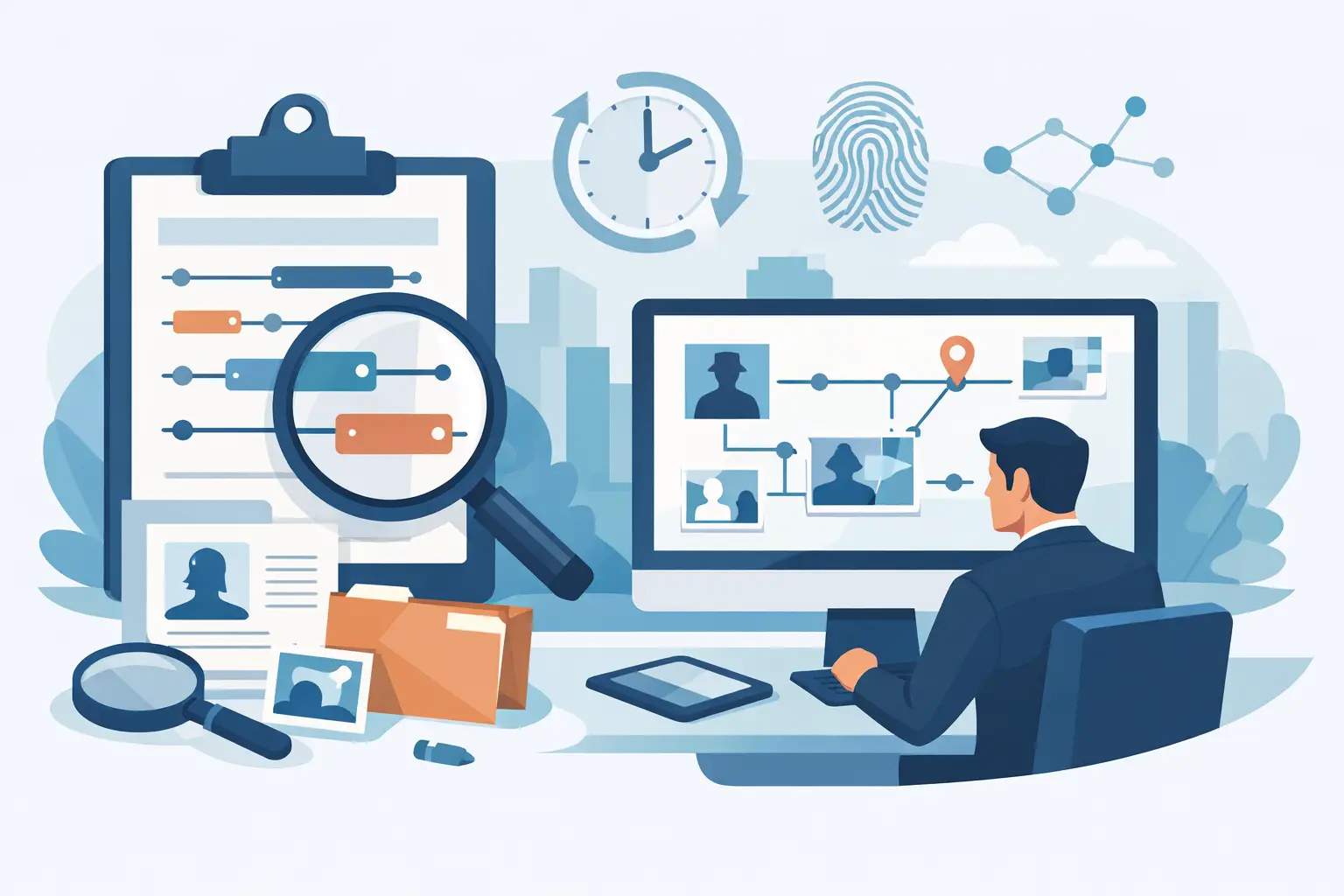
When a case turns on sequence, weak chronology work is rarely a minor administrative issue. A missed date, an unlinked exhibit or an untested conflict between witness accounts can affect findings, prolong hearings and undermine confidence in the process. That is why investigation chronology software matters in formal casework. In regulated environments, a chronology is not just a timeline. It is part of the evidential structure of the case.
For HR teams, governing bodies, regulators and disciplinary panels, the practical question is not whether a chronology can be produced. It is whether it can be produced consistently, defensibly and without creating new risks around version control, data handling or manual error. Many organisations still build chronologies in spreadsheets, word processing documents or ad hoc case folders. That may work for straightforward matters, but it becomes fragile very quickly once there are multiple witnesses, large evidence volumes, evolving allegations or panel deadlines.
Why investigation chronology software matters
In formal investigations, chronology work sits at the centre of case preparation. It helps investigators test the internal logic of the evidence, identify gaps, compare accounts and present events in a form that decision-makers can follow. If the chronology is incomplete or detached from the underlying records, the case team spends time checking, rechecking and manually reconciling updates across documents.
That creates several operational problems. First, teams lose confidence in whether they are working from the latest version. Second, evidential references become harder to verify, particularly where material is stored across email chains, shared drives and hearing bundle drafts. Third, auditability weakens. If an organisation later needs to explain how the chronology was built, what changed and who reviewed it, informal methods often do not stand up well.
Good software reduces those risks by treating chronology building as part of the case lifecycle rather than as an isolated writing exercise. The chronology should connect directly to referrals, evidence, witness material and outcome preparation. That structure matters because chronology quality depends on source control.
What good investigation chronology software looks like
The strongest systems do not merely arrange dates in order. They support disciplined case administration around each event entry. In practice, that means each item in the chronology should be traceable to source material, attributable to a user action and capable of review as the case develops.
A useful chronology tool should allow investigators to record events with precision, including date, time where relevant, description, source, status and relationship to allegations or issues under review. Just as important, it should distinguish between verified facts, witness assertions and procedural steps. In sensitive proceedings, those are not the same thing, and blending them carelessly can create avoidable confusion.
Evidence linkage is another basic requirement. If an event in the chronology refers to an interview note, document, message exchange or referral record, the investigator should be able to move directly to the underlying item within the same secure environment. That avoids the common problem of disconnected working files where the chronology says one thing and the evidence store says another.
Review controls matter as well. Chronologies change as disclosure expands, witness accounts are tested and new material is received. Software should make those changes visible. Version history, audit trails and permission controls are not optional features in this context. They are part of maintaining a defensible process.
Chronology software should support analysis, not just administration
There is a difference between a timeline and an investigative chronology. A timeline records sequence. An investigative chronology should also help the case team assess consistency, significance and relevance. This is where better software earns its place.
If two witnesses place a meeting on different dates, or if an account conflicts with a document trail, the chronology should help surface that discrepancy early. If a procedural deadline was missed, or if a safeguarding escalation happened after a key event rather than before it, the chronology should make that sequence easy to test. In other words, the value lies partly in visibility. Teams need to see where the case narrative is coherent and where it is under strain.
This is also where embedded AI can be useful, provided it sits inside a controlled and auditable workflow. AI-assisted chronology building can accelerate extraction of dates, draft event summaries from documents and compare witness accounts at speed. That can save significant preparation time, especially in document-heavy matters. The trade-off is that institutions should not treat machine-generated chronology content as self-proving. Human review remains essential, particularly where nuance, context or contested facts are involved.
For organisations handling sensitive data, the governance around AI matters as much as the feature itself. Case teams should ask where processing takes place, whether data is retained, whether models are trained on customer material and how outputs are logged. Speed is useful, but not if it introduces uncertainty around confidentiality or accountability.
Common gaps in basic tools
Many teams start with general-purpose tools because they are already available internally. The difficulty is that document editors, spreadsheets and generic project platforms were not built for formal investigations.
A spreadsheet may be adequate for listing events, but it is poor at evidence control and collaborative review. It becomes harder to manage once multiple users are updating entries, cross-referencing exhibits or preparing for hearings from the same underlying chronology. Formula errors, overwritten cells and ambiguous ownership are familiar problems.
Generic case folders create a different issue. They can store large amounts of material but do not impose procedural structure. Investigators then have to build their own naming conventions, review practices and chronology formats. That may suit highly experienced teams with low case volumes. It is less reliable where organisations need repeatability across departments, panel members or external consultants.
The real cost of these workarounds is usually not visible at procurement stage. It appears later in duplicated effort, inconsistent outputs, delayed hearing preparation and difficulty evidencing process quality under scrutiny.
How chronology software fits the full case lifecycle
The most effective approach is to treat chronology work as one part of a single secure platform rather than a separate document produced near the end of the investigation. Once referrals are logged, evidence is uploaded and witness material is captured in a structured environment, chronology building becomes more accurate because the inputs are already organised.
That has practical consequences at each stage. Early in the case, investigators can map known events and identify missing evidence. During evidence review, they can refine the sequence and test competing accounts. Before a hearing, they can use the chronology to support bundle preparation and panel orientation. After outcome, they can retain a clear record of how the factual sequence was established and considered.
This matters particularly for institutions that need consistency across repeated matters. If every case follows a different chronology method, quality depends too heavily on individual working habits. A standardised platform improves procedural discipline without forcing investigators into an inflexible template.
That balance is important. Over-structured systems can be frustrating in complex cases where events do not fit neatly into predefined categories. Under-structured systems create drift. Good software provides enough control to support governance while leaving room for professional judgement.
What buyers should ask before selecting investigation chronology software
For institutional users, the selection criteria should go beyond interface design. The software needs to stand up to operational and governance demands.
Security should be assessed first. Sensitive investigations require strong encryption, access controls, audit logging and clear data residency arrangements. In UK and EU settings, buyers will also want assurance around GDPR alignment and handling of AI-processed data.
Workflow fit is the next test. If chronology creation sits outside referral intake, evidence management, witness handling and hearing preparation, the organisation may simply be moving work between systems rather than reducing it. Integration within the case process usually matters more than an attractive standalone timeline view.
Buyers should also look closely at output quality. Can the chronology support referral reports, witness statement preparation, panel packs and final records without extensive manual reworking? If not, efficiencies may be limited.
Finally, ask how the platform handles scrutiny. A good system should make it easier to explain what happened in the case and what happened in the management of the case. Those are related but distinct requirements, and both matter where findings may be challenged.
Endaxi Brief is built around that full-lifecycle principle, combining chronology building with evidence control, hearing preparation and AI-assisted drafting in a single secure platform designed for sensitive casework from day one.
The standard is not speed alone
Fast chronology production is useful, but speed on its own is not a meaningful benchmark in disciplinary and regulatory work. The better question is whether the software helps teams produce chronologies that are accurate, reviewable and fit for formal decision-making.
That often means accepting a degree of structure and oversight in exchange for stronger defensibility. For most organisations running serious investigations, that is a sensible trade. A chronology should do more than help an investigator remember the order of events. It should help the organisation show, with confidence, how the case was assembled and why its process can be trusted.
When chronology work is handled properly, hearings run more clearly, review points surface earlier and case records hold together under pressure. That is usually where the real value lies.